They’re at it again. After losing in their attempt to torpedo net neutrality protections in California, Assembly members are back with a new and better way to make life easier for AT&T and Comcast.
VOIP may be a thing, but every message ultimately goes over wires controlled by a small number of corporations that don’t want regulations
California Assemblywoman Lorena Gonzalez’ AB 1366 would effectively keep California’s telecommunications network beyond the oversight of the California Public Utilities Commission or any other regulatory agency in California. The trick is to say that the CPUC can’t touch anything running with Internet Protocol, which now means pretty much all of the modern telecom network.
A coalition of privacy, civil rights and public interest groups sent a letter of concern about Facebook’s plan to introduce a digital currency.
The groups say Facebook’s new cryptocurrency raises “profound questions about national sovereignty, corporate power, consumer protection, competition policy, monetary policy, privacy and more.”
“The U.S. regulatory system is not prepared to address these questions. Nor are the regulatory systems of other nations or international institutions.”
More than 100 civil and human rights organizations, including Media Alliance, wrote to Senate Majority Leader Mitch McConnell to demand a vote on the Save The Internet Act, a bill which would restore Open Internet protections and passed the House of Representatives earlier this year.
The letter calls on Senator McConnell to “enact the will of the hundreds of millions of people who support Open Internet protections and broadband competition, and the millions who have taken action demanding them, by allowing Senators to act on the Save The Internet Act”.
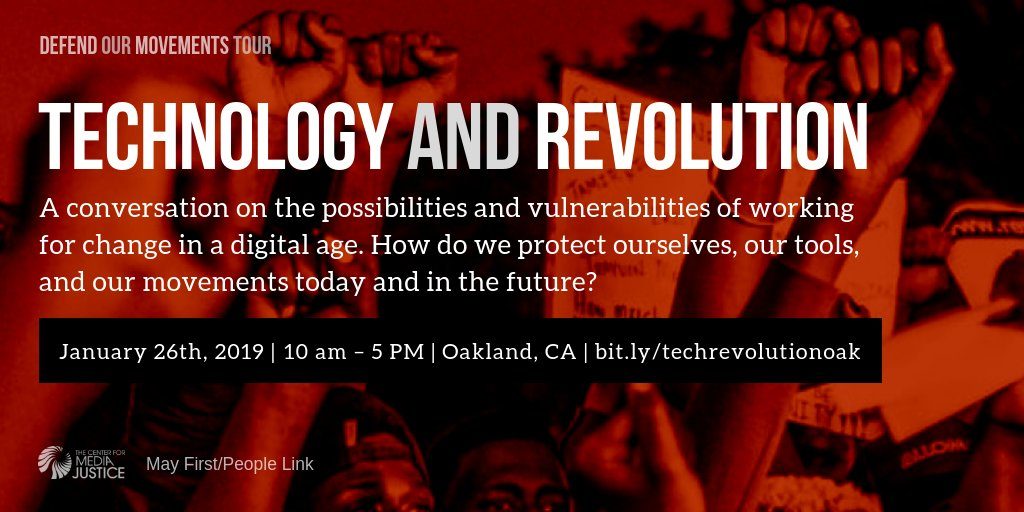
A conversation about technology and movement work. Last year nearly 1,000 activists participated in almost 20 sessions focused on discussing how movement activists and technologist across the country understood and prioritized the politics of technology through our Technology and Revolution Conversations.
In an attempt to develop a conversation that holds space for the many different perspectives and representations in tech and activist spaces we are traveling across the country as part of the Defend Our Movement Tour bringing back similar conversations and hoping that you will come join us. We all use technology. Many of our organizations even depend on it to do powerful and impactful work in our communities.
Our conversation on 1/26/19 will focus on uncovering the ways in which technology offers solutions to our work but also holds vast amounts of vulnerabilities considering the people and the communities we serve. We will be looking to expand and inform a unified strategy around how we use technology, how we protect both the technology we utilize and us as users, and how we identify our needs of technology for the future and security of our movement work.
Hosted by MayFirst/PeopleLink and the Center for Media Justice.
Saturday, 1/26/19
10:00 am – 5:00 pm
Greenlining Institute
360 14th st. 2nd floor
Oakland, CA 94612
You can register HERE. If you have additional questions, please feel free to reach out to me or Kyla, our Digital Justice Fellow and event facilitator at kyla@mediajustice.org.
Today, 34 civil rights, consumer, and privacy organizations join in releasing public interest principles for privacy legislation, because the public needs and deserves strong and comprehensive federal legislation to protect their privacy and afford meaningful redress.
Irresponsible data practices lead to a broad range of harms, including discrimination in employment, housing, healthcare, and advertising. They also lead to data breaches and loss of individuals’ control over personal information. Existing enforcement mechanisms fail to hold data processors accountable and provide little-to-no relief for privacy violations.
The privacy principles outline four concepts that any meaningful data protection legislation should incorporate at a minimum:
Privacy protections must be strong, meaningful, and comprehensive.
Data practices must protect civil rights, prevent unlawful discrimination, and advance equal opportunity.
Governments at all levels should play a role in protecting and enforcing privacy rights.
Legislation should provide redress for privacy violations.
Update: At 5pm on September 30, 7 hours before the deadline, Senate Bill 822 was signed into law, and California enacted the strongest net neutrality protections in the country, 10 months after the FCC repeal in December of 2017.
After a saga worthy of a Greek sailing epic, the California Legislature sent Senate Bill 822, the strongest statewide Net Neutrality bill yet to the states governor, Jerry Brown, for a signature.
24 prominent social justice groups wrote to the United States Senate to highlight Supreme Court nominee Kavanugh’s disturbing take on the 1st Amendment as expressed in his dissent in USTA vs FCC, the case that upheld the FCC’s 2015 Open Internet ruling in all respects.
Twenty consumer protection, privacy and civil rights groups urged the California Legislature today to resist industry attempts to neuter California’s new online privacy bill under the guise of “cleaning it up.”
The rushed passage of then Assembly bill 375 right in front of a ballot initiative deadline left the bill language signed by Governor Brown a bit typo-rich, so another bill Senate Bill 1121 was incorporated for clean-up purposes.