
Media Alliance joined the Reporters Committee for the Freedom of the Press and 15 other media organizations in filing an amici brief in Sacramento Superior Court in support of Pamela Lopez.
Continue reading Time’s Up: Amici Brief in Dababneh vs LopezCategory Archives: Accountability and Representation
When the media does us wrong and community accountability
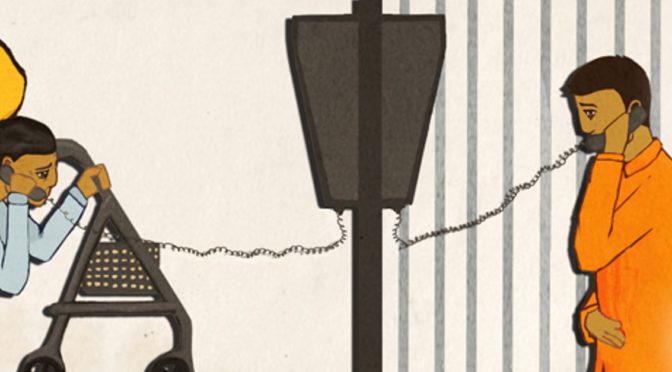
67 Social Justice Groups Demand Free Phone Calls From Prison
67 social justice groups, including Media Alliance, demanded that the FCC require the provision of free telephone calls from jails and prisons during the COVID-19 public health crisis. The groups pointed to the FCC’s Connect America pledge and asked why the prison telephone companies were not asked to help “keep America connected” during the crisis.
The letter states:
Incarcerated people are not able to socially distance while inside, and therefore are most vulnerable to contracting COVID-19. Moreover, in conditions where communications are limited, unjust practices may occur because incarcerated people are unable to communicate about dangerous crowding or lack of access to medical care. Adequate communications are a matter of civil rights and public health.
Continue reading 67 Social Justice Groups Demand Free Phone Calls From Prison
#ProtestFacebook
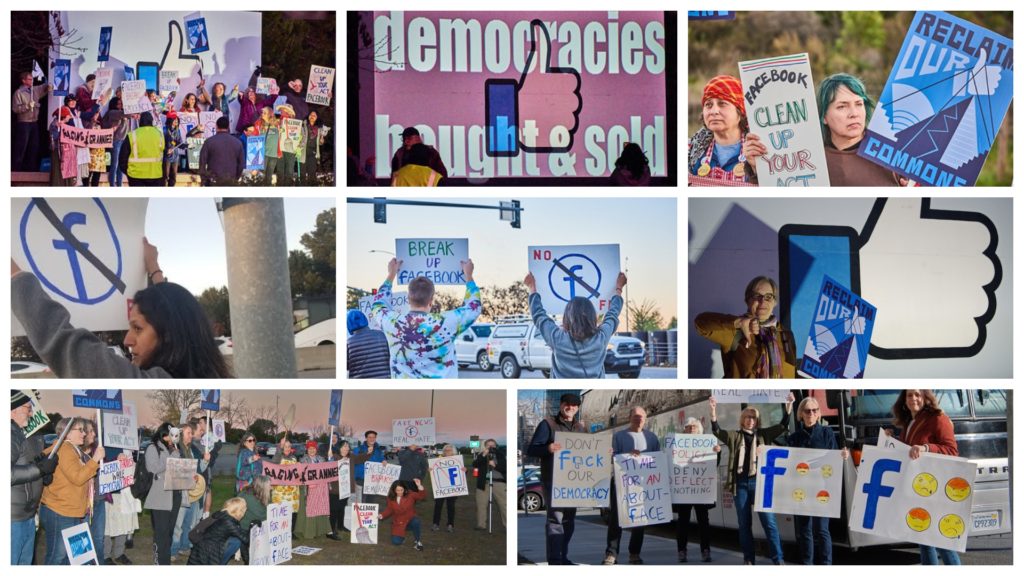
On February 17, President’s Day, activists organized by Media Alliance and Global Exchange took to the streets in San Francisco and Palo Alto to tell the world’s biggest social network to stop sabotaging democracy for profit.
In San Francisco, FB founder Mark Zuckerberg’s pied a terre in Dolores Heights was surrounded with chalk and signs and besieged with kazoos and whistles, as locals told a bevy of observing press that AI formulas sold to political candidates to abet the spread of viral disinformation was an unacceptable business plan.
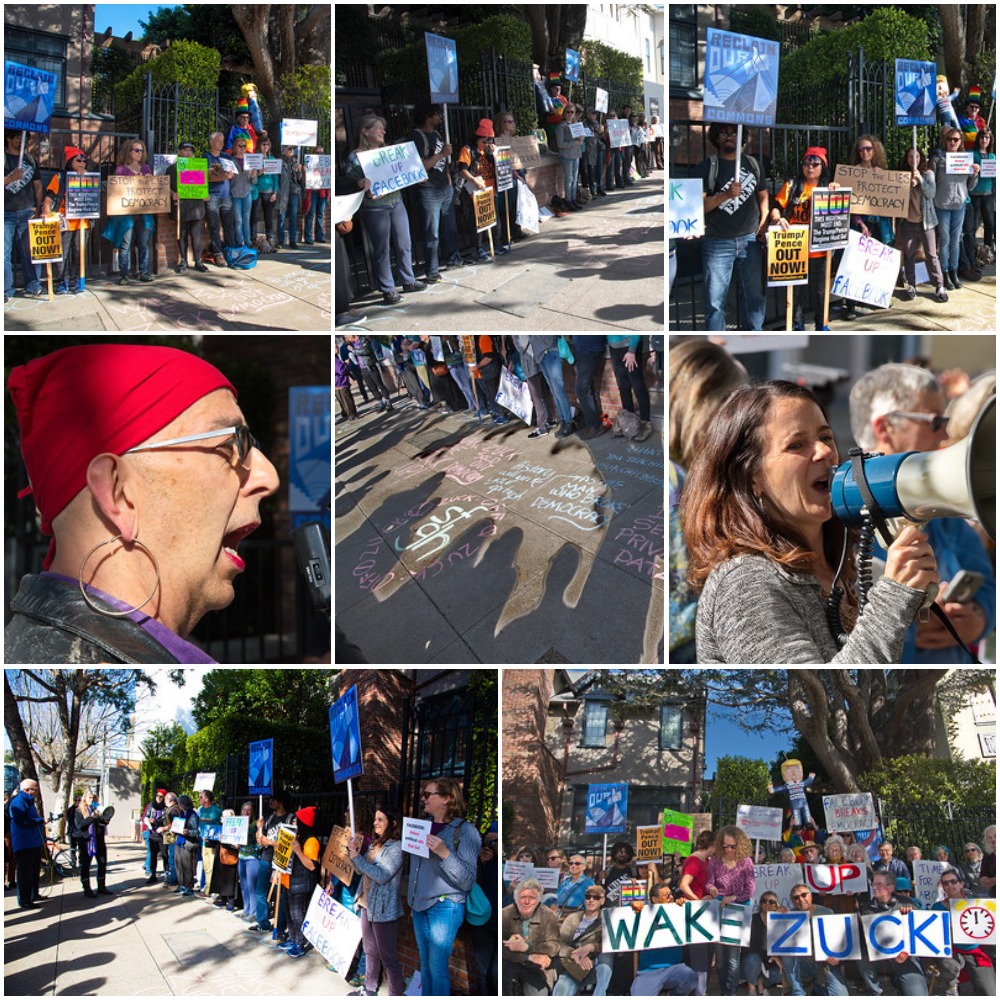
Images courtesy of Pro Bono Photos
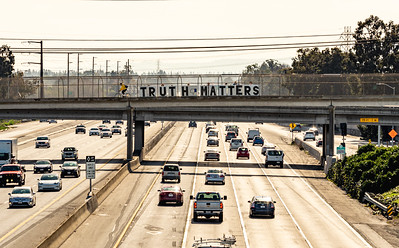
And in Palo Alto, “TRUTH MATTERS” hung over the Oregon Expressway overpass on Highway 101.
Neighbors in Dolores Heights and SF General (Chan-Zuckerberg) Hospital workers joined the San Francisco protest to highlight other disproportionate impacts from the Facebook founder on local communities.
For more on why SF’s safety net hospital should not bear the name of the Facebook founder, see this op-ed from Sasha Cutler from SEIU 1021.
Press Coverage: Newsweek, CNET, SF Gate, SF Examiner, KCBS Radio, SFIST, Xinhua, Mission Local, Breitbart
The President’s Day actions were the third in a series that began on January 9, 2020 with a protest outside Facebook headquarters and were followed by a Truth Matters human billboard the following week.
On February 28th, there will be an action at the headquarters of the Chan Zuckerberg Foundation.
On April 9, Earth Day, the campaign will speak up again with an emphasis on viral climate change denial.
For more on the campaign, visit the Protest Facebook website.
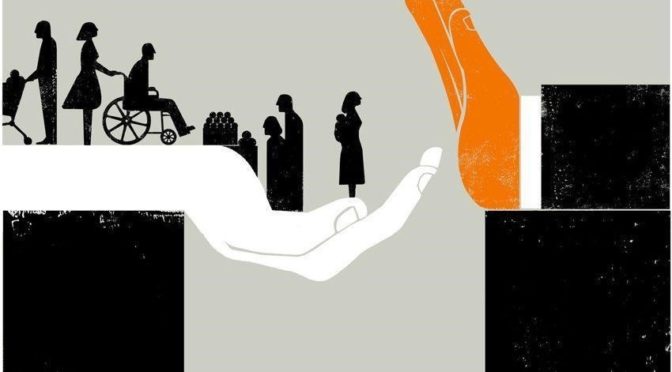
Legal Battle on Trump’s Public Charge Rule Not Over: Amici Curae in 9th Circuit Court
On January 27, the Supreme Court in a 5-4 decision allowed the “public charge” rule to temporarily go into effect by voiding a nationwide injunction issued by a federal judge.
However, the underlying legal process continues. Media Alliance is one of several parties to an amici filing coordinated by the National Consumer Law Center NCLC charging that the public charge rule was enacted in violation of the Administrative Procedure Act and constitutes an improper use of the credit reporting system.
Here is the amici filing.
Want fair elections? Help us protest Facebook.
by Ted Lewis and Tracy Rosenberg. Originally printed in the SF Examiner
Facebook looms over our coming elections, and not in a good way. The giant media company has tremendous power and influence — and a bad track record.
In 2016, Facebook was successfully used as part of multi-faceted election interference campaign. Called to account by Congress, Facebook CEO Mark Zuckerberg claimed that Russian ad buys and other efforts had little electoral impact in 2016, but the company later admitted that disinformation had reached 150 million Facebook and Instagram users in the United States.
The 2020 elections are already underway and protecting them now means more than deciding which candidates to support or pushing for ballot measures we believe in. This time, trust in our elections — the beating heart of our democracy – is at risk.
That is why protesting Facebook’s irresponsible policies is so urgent.
As a global media platform with billions of users, Facebook has the terrifying power to make or break the integrity of our elections. And in the near term are the only ones who can prevent the platform from being used to disrupt our elections — and elections around the world.
And while the Russian use of Facebook to interfere in the 2016 US elections is the most well-documented case of the company’s facilitation of efforts to sow discord, divisiveness, and disinformation, it is certainly not the only one.
In 2018, Facebook conceded its platform had been used to spread hate speech and disinformation that incited violence in Myanmar. The company commissioned a report about its role in human rights violations against the Rohingya Muslim minority in Myanmar, which stated that “Facebook has become a means for those seeking to spread hate and cause harm, and posts have been linked to offline violence.” Again in 2019, Facebook was used to amplify hate speech, harassment, and calls for violence in India against caste, religious, gender and queer minorities. The authors of a recent report by Equality Labs warn that without urgent intervention, hate speech on Facebook in India could trigger large-scale communal violence in that country.
Here in the US we must make sure Facebook does not again become a megaphone for disinformation and hate speech during the 2020 election.
But Facebook CEO Zuckerberg has made it clear that won’t be easy. Last October he announced the company would allow politicians and political parties to openly lie in their advertisements – meaning that Facebook now holds paid political advertisements to a lower standard than all others.
The time has surely come for Facebook’s monopoly to be broken up, but that is not going to happen before November 2020. So in the meantime it is up to us to pressure them directly. Corporations are susceptible to mass public pressure, and Facebook is no different. They don’t want their brand to be tarnished or to lose advertisers.
We have to start somewhere and conveniently, Facebook headquarters is in the San Francisco Bay Area, where there’s a long tradition of pressuring companies for change—whether to stop Gap and Nike from using sweatshop labor or convince Starbucks to buy coffee from Fair Trade farmers.
That’s why, on January 9, we’re kicking off a campaign that brings together human rights groups, media advocacy organizations, corporate campaigners and fed-up Facebook users to adopt the policies recommended by Facebook’s own employees in this public letter and to implement policies that discourage online hate, such as those recommended by Change the Terms.
Locally, we’ll be protesting outside of Facebook’s Menlo Park corporate headquarters under the banner, “Save Our Democracy: Protest Facebook.” Online, we’ll be “blacking out” Facebook on January 9 by replacing our Facebook cover and profile photos with a completely black box.
Some people say we should just abandon Facebook once and for all. But we’re not willing to cede a communications network that reaches billions of people to the unfettered practices of a corporation that cares more about its profits than about our democracy. Please join us in this fight.
Ted Lewis is the human rights director of Global Exchange. Tracy Rosenberg is the executive director of Media Alliance.

US Senate Consumer Privacy Bills
Multiple consumer privacy bills have been emerging from the federal government lately, mostly in response to state efforts like CCPA.
Here’s a letter from privacy groups, including Media Alliance, about the batch from the US Senate including COPRA from Senator Maria Cantwell D-WA), USCDPA from Senator Roger Wicker (R-MS) and the Browser Act from Senator Marsha Blackburn (R-TN).
Unsurprisingly, Cantwell’s bill comes the closest to a federal data privacy bill that would actually protect consumers.
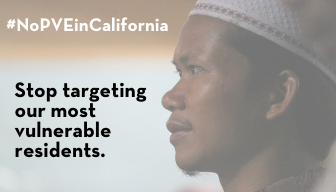
Anti-Muslim Hate Group Uses Same Name as State-Funded PVE Program
Update 6/30/2020. California’s state legislature has removed state staffing funding for the Preventing Violent Extremism program from the 2021 CA state budget. The NoPVEinCA Coalition celebrates the critical step taken by the state Legislature and the Committee on Budget to refuse state funding for PVE and CSC, surveillance programs modeled after the DHS and FBI’s “Countering Violent Extremism” (CVE) program, in response to community demands amplified and supported by the Coalition’s work.
Tracy Rosenberg, Advocacy Director at Oakland Privacy, states:
“Oakland Privacy completely rejects the methodology of CVE and CSC programs. Funding social service agencies and educational institutions to profile their constituencies as incipient terrorists based on religious or racial markers and vague behavioral characteristics will not keep us safe. Defunding these programs continues California’s rejection of the racist and xenophobic iniatives devised by the federal government that seek to criminalize the immigrant experience. Young people of color, in particular, deserve our support as they explore their identities. Educators and social service agencies should not be deputized as the eyes and ears of the surveillance state.”
See full coalition statement here.
Continue reading Anti-Muslim Hate Group Uses Same Name as State-Funded PVE Program
A Nonprofit Alliance Becomes an Ally of Big Telecom
How well-meaning, public-serving groups wound up as part of an alliance aimed at undermining state regulation of broadband and privacy laws.
BY CHRIS WITTEMAN AND TRACY ROSENBERG -NOVEMBER 24, 2019
Originally published in 48 Hills.
It’s not unusual for businesses to spend princely sums lobbying government to free them from regulations, which generally means consumer protections are reduced or eliminated. In a nutshell, that’s much of what goes on in the halls of government, as we’ve previously reported.
But it is a bit more unconventional when a self-described coalition of nonprofit organizations promotes the same agenda as large telecom companies, putting consumers at the short end of the stick.
Continue reading A Nonprofit Alliance Becomes an Ally of Big Telecom