All posts by Midnightschildren

‘Wake up Zuck’: Protesters gather outside of Facebook founder’s home, demand regulation of political ads

by Loi Almeron and Justin Mark. Originally printed in SF Gate and Mission Local

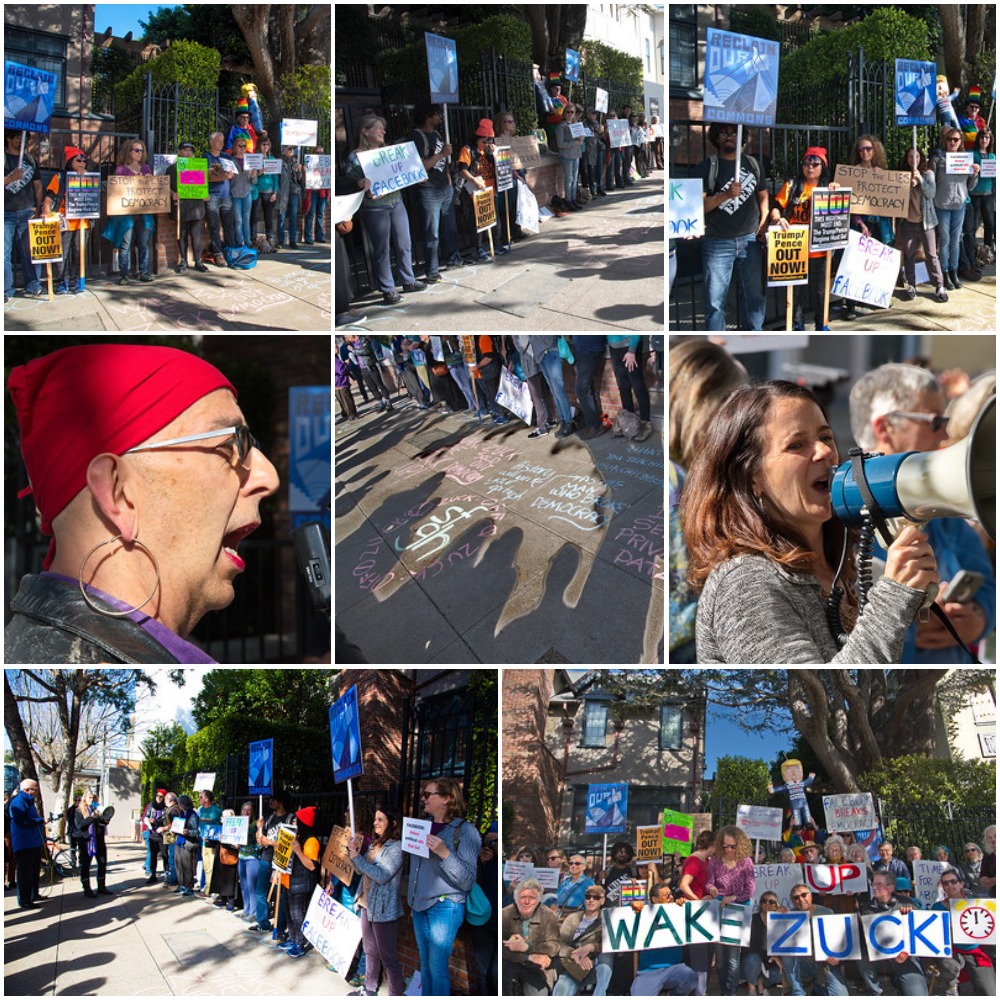
On Monday morning around 10 a.m., about 50 protesters gathered outside of Facebook founder and CEO Mark Zuckerberg’s home in the Mission District to protest the social media giant’s use of personal data and refusal to regulate misleading political advertisements.

“We’re sick and tired of waiting for the government to regulate Facebook,” said Tracy Rosenberg, the executive director of Media Alliance and one of the protest’s organizers. “You’re profiting off of us — you’re selling our information.”

Continue reading ‘Wake up Zuck’: Protesters gather outside of Facebook founder’s home, demand regulation of political ads

#ProtestFacebook

On February 17, President’s Day, activists organized by Media Alliance and Global Exchange took to the streets in San Francisco and Palo Alto to tell the world’s biggest social network to stop sabotaging democracy for profit.

In San Francisco, FB founder Mark Zuckerberg’s pied a terre in Dolores Heights was surrounded with chalk and signs and besieged with kazoos and whistles, as locals told a bevy of observing press that AI formulas sold to political candidates to abet the spread of viral disinformation was an unacceptable business plan.

Images courtesy of Pro Bono Photos

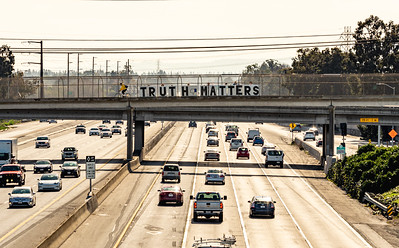
And in Palo Alto, “TRUTH MATTERS” hung over the Oregon Expressway overpass on Highway 101.

Image courtesy of Pro Bono Photos

Neighbors in Dolores Heights and SF General (Chan-Zuckerberg) Hospital workers joined the San Francisco protest to highlight other disproportionate impacts from the Facebook founder on local communities.

For more on why SF’s safety net hospital should not bear the name of the Facebook founder, see this op-ed from Sasha Cutler from SEIU 1021.

Press Coverage: Newsweek, CNET, SF Gate, SF Examiner, KCBS Radio, SFIST, Xinhua, Mission Local, Breitbart

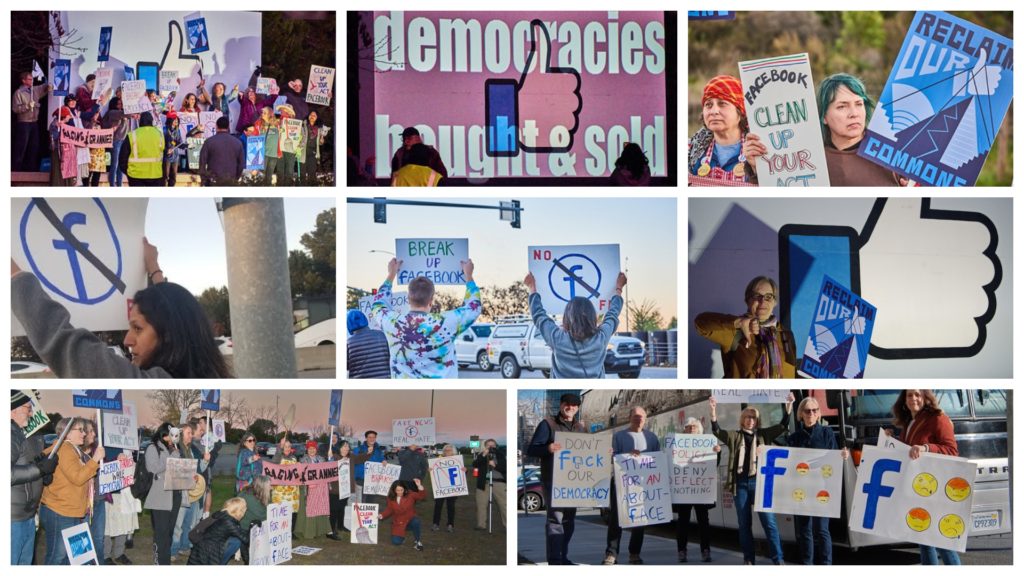
The President’s Day actions were the third in a series that began on January 9, 2020 with a protest outside Facebook headquarters and were followed by a Truth Matters human billboard the following week.

On February 28th, there will be an action at the headquarters of the Chan Zuckerberg Foundation.

On April 9, Earth Day, the campaign will speak up again with an emphasis on viral climate change denial.

For more on the campaign, visit the Protest Facebook website.

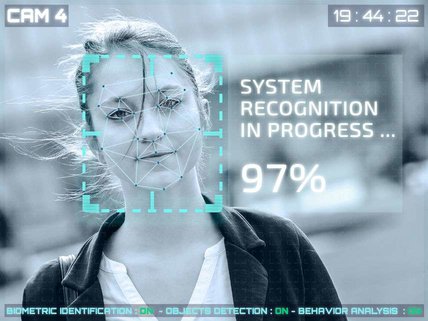
40 Civil Rights Groups Ask Colleges to Keep Facial Recognition Off Campuses

An open letter from an assortment of civil rights groups, including Media Alliance, asked university administrators to keep their campuses free of facial recognition.

On March 2, students and faculty at schools across the country will organize to reject facial recognition’s false promises of safety, and stand against the idea of biased 24/7 tracking and analysis of everyone on campus.

Dozens of schools have clarified that they don’t use or plan to use the technology, while about one third have not responded. Three schools—George Washington University, Duke University, and American University—gave vague statements that implied they may have plans to use facial recognition in the future. And UCLA and Tufts University currently use or have plans to use the technology on its campus.

Campuses that have stated they have no intention of using facial recognition include Boston College, Brown University, Columbia University, Colorado State University, Cornell University, Dartmouth College, DePaul University, MIT, Michigan State University, Georgia Tech, NYU, Hampshire College, Kent State University, Rice University, University of Florida, Oregon State University, UPenn, and John Hopkins University. University of San Francisco clarified that it abandoned its controversial facial recognition program in 2016. Activists made multiple attempts to contact every institution on the scorecard. More than 30 schools did not respond after multiple attempts, including Harvard, Yale, Oberlin, Howard University, Ohio State, Reed, and Sarah Lawrence College.

Kick The Tires of the CCPA

In celebration of Data Privacy Day (earlier this week), and the operational start of the California Consumer Privacy Act (CCPA), privacy advocates invited CA legislators to take the law out for a spin.

Our practice companies: Tik-ToK, a youth-oriented social media network, and Experian, one of the 3 leading credit bureaus in the country

While legislators are trying out their new law, you can also join the impromptu test. See if you can find out what Tik-Tok and Experian have collected about you, and ask them to stop selling it, and tell us how it goes!

Continue reading Kick The Tires of the CCPA

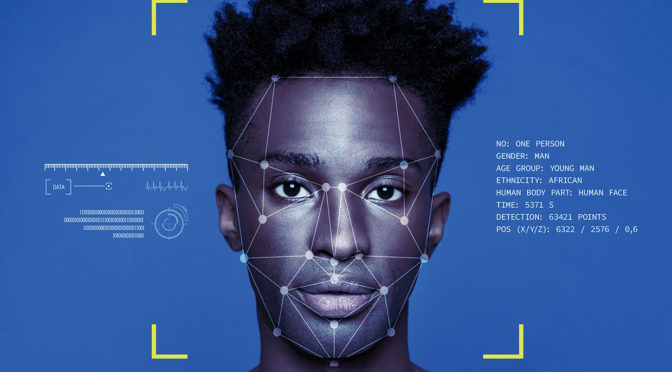
40 Groups Ask Oversight Board For Facial Recognition Moratorium

40 groups, including Media Alliance, wrote to the Privacy and Civil Liberties Oversight Board (PCLOB) urging it to call for the suspension of all facial recognition use pending further review.

The letter states: The PCLOB has a unique responsibility, set out in statute, to assess technologies and policies that impact the privacy of Americans after 9-11 and to make recommendations to the President and to the executive branch. The rapid and unregulated deployment of facial recognition poses a direct threat to “the precious liberties that are vital to our way of life”. We urge the PCLOB to act now to safeguard the privacy rights of Americans.

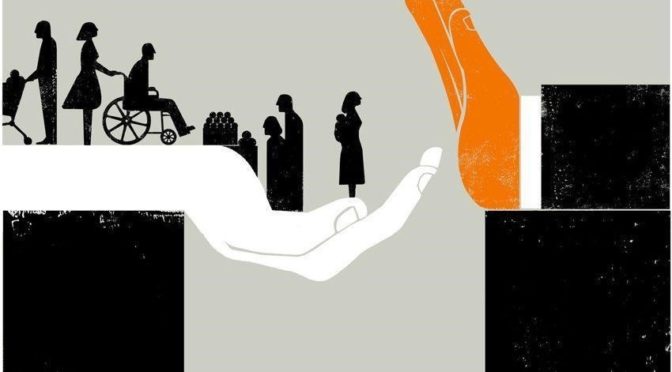
Legal Battle on Trump’s Public Charge Rule Not Over: Amici Curae in 9th Circuit Court

On January 27, the Supreme Court in a 5-4 decision allowed the “public charge” rule to temporarily go into effect by voiding a nationwide injunction issued by a federal judge.

However, the underlying legal process continues. Media Alliance is one of several parties to an amici filing coordinated by the National Consumer Law Center NCLC charging that the public charge rule was enacted in violation of the Administrative Procedure Act and constitutes an improper use of the credit reporting system.

Here is the amici filing.

Want fair elections? Help us protest Facebook.

by Ted Lewis and Tracy Rosenberg. Originally printed in the SF Examiner

Facebook looms over our coming elections, and not in a good way. The giant media company has tremendous power and influence — and a bad track record.

In 2016, Facebook was successfully used as part of multi-faceted election interference campaign. Called to account by Congress, Facebook CEO Mark Zuckerberg claimed that Russian ad buys and other efforts had little electoral impact in 2016, but the company later admitted that disinformation had reached 150 million Facebook and Instagram users in the United States.

The 2020 elections are already underway and protecting them now means more than deciding which candidates to support or pushing for ballot measures we believe in. This time, trust in our elections — the beating heart of our democracy – is at risk.

That is why protesting Facebook’s irresponsible policies is so urgent.

As a global media platform with billions of users, Facebook has the terrifying power to make or break the integrity of our elections. And in the near term are the only ones who can prevent the platform from being used to disrupt our elections — and elections around the world.

And while the Russian use of Facebook to interfere in the 2016 US elections is the most well-documented case of the company’s facilitation of efforts to sow discord, divisiveness, and disinformation, it is certainly not the only one.

In 2018, Facebook conceded its platform had been used to spread hate speech and disinformation that incited violence in Myanmar. The company commissioned a report about its role in human rights violations against the Rohingya Muslim minority in Myanmar, which stated that “Facebook has become a means for those seeking to spread hate and cause harm, and posts have been linked to offline violence.” Again in 2019, Facebook was used to amplify hate speech, harassment, and calls for violence in India against caste, religious, gender and queer minorities. The authors of a recent report by Equality Labs warn that without urgent intervention, hate speech on Facebook in India could trigger large-scale communal violence in that country.

Here in the US we must make sure Facebook does not again become a megaphone for disinformation and hate speech during the 2020 election.

But Facebook CEO Zuckerberg has made it clear that won’t be easy. Last October he announced the company would allow politicians and political parties to openly lie in their advertisements – meaning that Facebook now holds paid political advertisements to a lower standard than all others.

The time has surely come for Facebook’s monopoly to be broken up, but that is not going to happen before November 2020. So in the meantime it is up to us to pressure them directly. Corporations are susceptible to mass public pressure, and Facebook is no different. They don’t want their brand to be tarnished or to lose advertisers.

We have to start somewhere and conveniently, Facebook headquarters is in the San Francisco Bay Area, where there’s a long tradition of pressuring companies for change—whether to stop Gap and Nike from using sweatshop labor or convince Starbucks to buy coffee from Fair Trade farmers.

That’s why, on January 9, we’re kicking off a campaign that brings together human rights groups, media advocacy organizations, corporate campaigners and fed-up Facebook users to adopt the policies recommended by Facebook’s own employees in this public letter and to implement policies that discourage online hate, such as those recommended by Change the Terms.

Locally, we’ll be protesting outside of Facebook’s Menlo Park corporate headquarters under the banner, “Save Our Democracy: Protest Facebook.” Online, we’ll be “blacking out” Facebook on January 9 by replacing our Facebook cover and profile photos with a completely black box.

Some people say we should just abandon Facebook once and for all. But we’re not willing to cede a communications network that reaches billions of people to the unfettered practices of a corporation that cares more about its profits than about our democracy. Please join us in this fight.

Ted Lewis is the human rights director of Global Exchange. Tracy Rosenberg is the executive director of Media Alliance.