A coalition of privacy, civil rights and public interest groups sent a letter of concern about Facebook’s plan to introduce a digital currency.
The groups say Facebook’s new cryptocurrency raises “profound questions about national sovereignty, corporate power, consumer protection, competition policy, monetary policy, privacy and more.”
“The U.S. regulatory system is not prepared to address these questions. Nor are the regulatory systems of other nations or international institutions.”
Sports enthusiasts heading to Tokyo for the 2020 Summer Olympics beware: Japan intends to install hundreds of thousands of facial recognition cameras to identify everyone in attendance. The software, initially used when Tokyo hosted the Paralympic games in 2018, is meant to weed out, in real time, people suspected of being potential terrorists — and anyone with a criminal record or questionable immigration status.
Is fate just another word for the prison-industrial complex?
That’s where playright Luis Alfaro and the Magic Theater are pushing us in Oedipus El Rey, now revived at the Magic’s Fort Mason Theater for its 10 year anniversary.
More than 100 civil and human rights organizations, including Media Alliance, wrote to Senate Majority Leader Mitch McConnell to demand a vote on the Save The Internet Act, a bill which would restore Open Internet protections and passed the House of Representatives earlier this year.
The letter calls on Senator McConnell to “enact the will of the hundreds of millions of people who support Open Internet protections and broadband competition, and the millions who have taken action demanding them, by allowing Senators to act on the Save The Internet Act”.
The world’s most popular yet most controversial weed killer, Roundup, has been under severe scrutiny as consumers allege that the product has caused their various health issues and cancers. The active ingredient that reportedly causes these complications, glyphosate, has been deemed “probably carcinogenic for humans” by the International Agency for Research on Cancer. Since this classification, thousands of consumers have sought legal assistance to go against manufacturer Monsanto, newly acquired by pharmaceutical giant Bayer, for selling a product they knew could be dangerous to their customers.
It was recently revealed that more than 13,400 consumers have filed lawsuits against Bayer and its subsidiary Monsanto for its Roundup product. So far, three heavily covered lawsuits have gone through American courts, all resulting in huge losses for the manufacturing company. These notable cases have paved the way for the rest of the pending suits and for consumers who have suffered because of Roundup.
A 70-strong coalition of social justice and civil rights groups led by M-Power Change, Asian-Americans Advancing Justice and CAIR California (including Media Alliance) sent a letter to CA Governor Gavin Newson asking him to end the reinstatement of a washed-over version of the DHS Countering Violent Extremism (CVE) program, now repackaged as a California state program called Preventing Violent Extremism. (PVE).
The letter states “PVE programs are deceptively framed as public health and youth programs that offer social services to marginalized communities. Such a framing masks the true objectives; to surveil, profile and collect intelligence on Muslim, immigrant and Black and Brown communities…. These programs stigmatize the very communities they purport to help, making them less likely to seek legitimate social services for fear it will lead to unwarranted law enforcement scrutiny.
A California state senator representing the Hayward-Fremont-Milpitas area is saying he will sink a bill (Senate Bill 561) that gives Californians the right to sue if companies break the law.
Senate Bill 561, authored by Hannah Beth Jackson and sponsored by CA’s Attorney General Xavier Becerra, lets state residents take independent legal action if any of the rights granted to them by the new law are violated, including the right to know where their personal information is being sold and to withhold consent for data sales. Without the bill, consumers will have little recourse if some companies don’t voluntarily comply.
Senator Wieckowski’s office refused to meet with a group of constituents in his district, a meeting Media Alliance and Oakland Privacy offered to convene, saying the entire legislative staff was “too busy” to meet every single day from May 6 to May 15.
When asked what a constituent should do if a company ignores their request to opt out under CCPA, the senator’s legislative director Heather Resetarits replied: ” I understand your frustration and the Senator understands the arguments for the merits of the policy contained in the bill.”
Wieckowski, one of four Democrats on the Senate Appropriations committee whose vote will be required to advance SB 561, says he is loyal to “a deal” struck with real estate developer Alastair MacTaggart in 2018 to remove McTaggart’s initiative from the 2018 ballot. The ballot initiative, which was supported by 600,000 Californians, had a right to sue or a private right of action. It was taken out in the “deal”, which happened in a back room without the permission of those 600,000 Californians or the other 39 million Californians who were having their privacy rights trimmed.
The right to privacy is enshrined in the California state constitution. The preamble to the California Privacy Act states:
It is the intent of the Legislature to further Californians’ right to privacy by giving consumers an effective way to control their personal information, by ensuring the following rights:(1) The right of Californians to know what personal information is being collected about them.(2) The right of Californians to know whether their personal information is sold or disclosed and to whom.(3) The right of Californians to say no to the sale of personal information.(4) The right of Californians to access their personal information.(5) The right of Californians to equal service and price, even if they exercise their privacy rights.
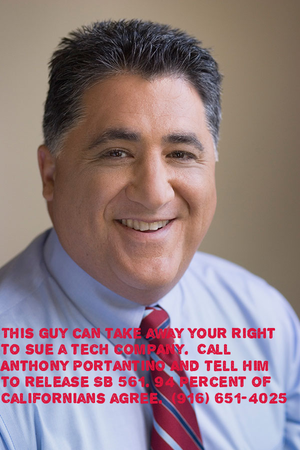
Rights you can only exercise if a company voluntarily agrees aren’t rights, they are requests.Unenforceable requests. Attorney General Becerra, in sponsoring Senate Bill 561 said: “I urge you to provide consumers with a private right of action under CCPA”. A March 2019 poll said 94% of California voters want to be able to take a company to court if the company violates their privacy rights.
Senator Bob Wieckowski is telling you he is going to ignore 94% of the voters, make your constitutional rights unenforceable, and won’t meet with his own angry constituents because of a backroom deal with the the one percent to protect companies that won’t comply with the law. Who is he representing?
Here is how to reach him: Sacramento: (916) 651-4010 Fremont: (510) 794-3900
Bowing to overwhelming consensus, California’s legislature enacted the California Consumer Privacy Act (CCPA) in 2018, with an effective date of January 1, 2020.
But there’s something else that 94% of the population would also like. They would like to be able to take a tech company to court if that company violates their privacy rights.
Makes sense. It doesn’t do much good if you can ask a company to disclose who they are sharing your personal information with but they can refuse to tell you. It doesn’t do much good if you can ask a company not to sell your data and they can ignore you.
But you don’t have to take it from me. California’s Attorney General says the same thing.
In a letter to the Legislature, California’s Attorney General Xavier Becerra said “The CCPA does not include a private right of action that would allow consumers to seek legal remedies for themselves to protect their privacy … I urge you to provide consumers with a private right of action under the CCPA. … If we fail to address these issues, it is the people of California who stand to lose.”
The AG walked his talk and sponsored a bill, Senate Bill 561, to let you sue a company that violates your privacy rights under the new law. But rumor has it that a small group of state senators on the CA Senate Appropriations committee haven’t pledged to support SB 561 and may let it die on the vine in two weeks.
The California Senate Appropriations committee is just six people, 4 Democrats and 2 Republicans. Since Democrats have the overwhelming majority, as they do throughout California’s legislature, what it comes down to is that these four CA Democrats might steal your right to sue tech companies when they sell your personal information without your consent.
This can’t and shouldn’t happen. But the person who cares most about your rights is …. you.
Call committee chair Anthony Portantino today. (916) 651–4025.